Budget 2027 Property Market Outlook: Should You Buy or Invest in Malaysia?
Does Budget 2027 mean it's a good time to buy property in Malaysia?
Malaysia Budget 2027 was tabled on 9 October 2026, and homebuyers and investors have good reason to look closely at the Budget 2027 property market outlook.
The government has proposed stamp duty relief for first-time buyers, wider housing financing support, and investment in industrial zones, infrastructure and public transport.
These measures could change how much cash you need upfront, how easily you get a loan, and which areas attract demand in the years ahead.
But a Budget lands on a market that already exists. The real question is what these measures will change in a market that was already slowing.
The short answer: it can be a good time for some buyers, but not because of the Budget alone. Prices have flattened, unsold stock is rising and rents are still firm, which gives prepared buyers more room to negotiate. Whether it is right for you depends on your finances, your purpose and the local market.
In this guide, we look at where the market stood before Budget 2027 using official NAPIC and DOSM data and IQI's own transaction records, then explain what the Budget could change for buyers and investors.
TL;DR
- The market was cooling before Budget 2027. NAPIC recorded 110,998 residential transactions in H1 2026, down 7.7% year on year.
- Price growth has slowed sharply. The Malaysian House Price Index rose just 0.9% in Q2 2026, the slowest pace since 2022. The national average house price is RM506,317.
- Unsold stock is rising. Residential overhang reached 33,094 units worth RM17.78 billion at end-June 2026, up 23.0% year on year.
- States are moving in different directions. Johor prices rose 3.6% and Kuala Lumpur 2.7%, while Selangor fell 1.1% and its overhang jumped 69.8%.
- Rents are still rising. Across 48,214 tenancies handled by IQI agents, the average residential rent in six states rose 5.0% from 2023 to 2025, led by Johor at 22.8%.
- Budget 2027 targets first-time buyers. Proposed stamp duty relief covers homes up to RM750,000, and SJKP guarantees of up to RM20 billion aim to help about 80,000 buyers.
- Before buying: judge the local data (prices, overhang, launch take-up) and your own affordability, not the Budget headlines alone.
What's inside:
- Does Budget 2027 mean it's a good time to buy property in Malaysia?
- TL;DR
- Where did Malaysia's property market stand before Budget 2027?
- How did each state perform in H1 2026?
- What do IQI's own transactions show?
- Will Budget 2027 make buying a home more affordable?
- Could more Malaysians qualify for housing financing?
- Could Budget 2027 affect property prices in Malaysia?
- Which Malaysian property markets could benefit from Budget 2027?
- Will better public transport make certain properties more attractive?
- Could tourism growth create more rental property opportunities?
- Malaysia property investment 2027: what risks should investors consider?
- Malaysia property market outlook 2027: what could change after the Budget?
- Should you buy or invest in property after Budget 2027?
- What should real estate agents focus on after Budget 2027?
- Frequently asked questions about the Budget 2027 property market outlook
- Final thoughts: Budget 2027 creates opportunities, but the data says choose carefully
Where did Malaysia's property market stand before Budget 2027?
To judge the Budget 2027 property impact, you first need a baseline. NAPIC's H1 2026 reports, released in September 2026, give the clearest picture of the market just before the Budget.
The short version: 2025 was a record year by value, but momentum faded in the first half of 2026.
Malaysia's property market at a glance (2024 to H1 2026)
Indicator | 2024 | 2025 | H1 2026 | H1 2026 vs H1 2025 |
|---|---|---|---|---|
All property transactions | 420,545 | 416,413 | 187,320 | -4.5% |
All property transaction value | RM232.30 bil | RM241.87 bil | RM105.12 bil | -2.4% |
Residential transactions | 260,516 | 256,512 | 110,998 | -7.7% |
Residential transaction value | RM106.92 bil | RM108.27 bil | RM47.11 bil | -4.6% |
House price growth (MHPI) | +3.3% | +2.6% | +0.9% | Slowest since 2022 |
Average house price | RM490,313 | RM502,922 | RM506,317 | +0.9% |
New residential launches (units) | 75,784 | 64,487 | 27,832 | -25.3% |
New launch sales rate | 37.3% | 35.5% | 16.6% | Down from 24.0% |
Residential overhang (units) | 23,149 | 30,471 | 33,094 | +23.0% |
Residential overhang (value) | RM13.94 bil | RM17.73 bil | RM17.78 bil | +8.2% |
Serviced apartment overhang (units) | 19,564 | 18,752 | 23,375 | +30.7% |
Unsold units under construction | 60,934 | 72,384 | 58,611 | -9.9% |
Source: NAPIC / JPPH Property Market Report 2025 and H1 2026, Property Market Status Report H1 2026, MHPI Q1 to Q2 2026P. H1 2026 price figures compare Q2 2026 (preliminary) with Q2 2025. Overhang means completed homes unsold for more than nine months. NAPIC revises earlier figures; revised numbers are used where available.
What do these numbers tell us?
Four signals stand out.
- Fewer homes changing hands. Residential transactions fell 7.7% year on year in H1 2026, after a 1.5% dip in 2025.
- Prices are flattening, not falling. The national average rose to RM506,317, but growth of 0.9% is below inflation of about 1.8%. In real terms, prices were roughly flat.
- New launches are struggling to sell. Only 16.6% of units launched in H1 2026 were sold. For high-rise launches, the rate was just 8.2%, against 22.8% for landed homes.
- Unsold completed homes are piling up. The overhang rose 8.6% in six months, from 30,471 units at end-2025 to 33,094 at end-June 2026.
There is a positive side too. Developers have responded by launching 25.3% fewer units, and unsold units under construction fell 19.0% from end-2025. That is supply discipline, and it matters for where prices go next.
Strong economy, cooler housing market
The slowdown is not because the economy is weak. DOSM data shows the opposite.
Economic indicator | Latest figure | Period |
|---|---|---|
Real GDP growth | 5.7% | H1 2026 (Q1 5.4%, Q2 6.0%) |
Unemployment rate | 3.0% | June 2026 |
Headline inflation | 1.8% | H1 2026 average |
Median household income | RM7,017 / month | 2024 (latest survey) |
Median formal-sector wage | RM3,027 / month | March 2026 (+0.9% YoY) |
Source: DOSM / OpenDOSM, data as at 5 October 2026.
Growth near 6% and unemployment at 3.0% normally support housing demand. Yet transactions fell.
That gap points to affordability and buyer caution, not a lack of jobs. It is also exactly the gap Budget 2027's first-buyer measures are trying to close.
How did each state perform in H1 2026?
National averages hide big regional differences. Here is how the six states most relevant to Budget 2027 compared.
State | Avg house price | Price change (MHPI) | Residential transactions | Overhang (units) | Launch sales rate |
|---|---|---|---|---|---|
Kuala Lumpur | RM825,282 | +2.7% | 6,618 (+2.4%) | 3,687 (+1.2%) | 20.7% |
Selangor | RM561,187 | -1.1% | 22,389 (-10.5%) | 4,185 (+69.8%) | 6.8% |
Johor | RM489,881 | +3.6% | 17,871 (-15.1%) | 4,222 (+31.6%) | 36.5% |
Penang | RM503,388 | +0.2% | 6,979 (-13.1%) | 3,114 (+25.3%) | 9.8% |
Sabah | RM558,358 | +2.9% | 2,731 (-1.5%) | 1,887 (-4.1%) | 22.3% |
Sarawak | RM574,099 | +2.7% | 5,109 (+2.4%) | 1,704 (+11.7%) | 11.6% |
Malaysia | RM506,317 | +0.9% | 110,998 (-7.7%) | 33,094 (+23.0%) | 16.6% |
Source: NAPIC regional property market reports H1 2026, Property Market Status Report H1 2026, MHPI Q1 to Q2 2026P. Changes are H1 2026 vs H1 2025 (prices: Q2 2026P vs Q2 2025). Launch sales rate = share of units launched in H1 2026 that were sold.
A few things jump out:
- Johor led price growth for a third year (+6.7% in 2024, +6.9% in 2025, +3.6% in H1 2026) and had the best launch sales rate. But it also had the largest overhang of the six states.
- Selangor was the only one of the six where prices fell. Its overhang rose almost 70%, and just 6.8% of new launches sold.
- Kuala Lumpur held up best on volume. Nearly one in four KL residential deals (23.5%) was above RM1 million, against 5.8% nationally.
- Sabah and Sarawak were steadier, with prices up 2.9% and 2.7% and smaller overhangs.
Together, these six states hold 18,799 overhang units, or about 57% of Malaysia's unsold completed homes. Location matters more than ever.
What do IQI's own transactions show?
NAPIC shows what happened across the whole market. IQI's own records show what buyers and tenants actually paid on the ground.
We analysed 97,001 residential transactions handled by IQI agents in the same six states from 2023 to 2026: 29,849 new-launch bookings, 18,938 subsales and 48,214 tenancies.
State | Avg new-launch price (2025) | Avg subsale price (2025) | Avg monthly rent (2025) | Rent change, 2023 to 2025 | Avg rent, 2026 to date | Indicative gross yield (2025) |
|---|---|---|---|---|---|---|
Kuala Lumpur | RM748,244 | RM929,258 | RM2,938 | +6.1% | RM3,073 | 3.8% |
Selangor | RM597,686 | RM567,967 | RM1,861 | +3.9% | RM2,001 | 3.9% |
Johor | RM726,529 | RM560,405 | RM2,227 | +22.8% | RM2,097 | 4.8% |
Penang | RM758,663 | RM568,824 | RM1,994 | +2.2% | RM2,055 | 4.2% |
Sabah | RM426,885 | RM497,433 | RM2,034 | +2.3% | RM2,071 | 4.9% |
Sarawak | RM386,829 | RM598,794* | RM1,727 | +7.3% | RM1,691 | 3.5%* |
Six states | RM647,630 | RM631,701 | RM2,202 | +5.0% | RM2,277 | 4.2% |
Source: IQI Global transaction records, residential properties only, grouped by property location, cancelled deals excluded. 2026 figures are year to date as at 7th October 2026. Averages reflect the homes IQI agents transacted, not the whole market. Indicative gross yield = average annual rent ÷ average subsale price; the rented and sold homes are different properties, so treat it as a rough guide. *Sarawak subsale figure based on a small sample (89 transactions).
Four findings stand out.
- Rents are still rising. The average residential rent across the six states rose from RM2,098 in 2023 to RM2,202 in 2025, and is RM2,277 so far in 2026. While house prices stalled, tenant demand held up.
- Johor rents jumped 22.8% between 2023 and 2025, the sharpest rise of the six states and consistent with JS-SEZ-related demand. But they have eased to RM2,097 in 2026 so far, as Johor's overhang climbed.
- New launches cost more than subsales in Johor and Penang. IQI's new-launch buyers in Johor paid 29.6% more on average than subsale buyers in 2025. In Penang, the gap was 33.4%. Newer, larger units explain part of that, but it is a good reason to compare both before committing.
- KL's subsale market is moving upmarket. The average KL subsale handled by IQI rose 25.8%, from RM738,667 in 2023 to RM929,258 in 2025. That matches NAPIC's finding that KL's RM1 million+ residential deals grew 24.9% in 2025.
Put together with NAPIC's figures, the picture is clear: a softer sales market, but a rental market that is still firm in most states.
Will Budget 2027 make buying a home more affordable?
For most Malaysians, affordability is the biggest consideration when buying a home.
Using matched 2024 data, the average house price (RM490,313) was about 5.8 times the median annual household income (RM84,204). That is well above the 3.0 times benchmark commonly used to define affordable housing.
Indicative only. NAPIC's average price includes higher-value homes, so it sits above the median house price. DOSM's next household income survey (2026) is due in 2027.
Budget 2027 does not change that ratio directly. But it does introduce measures that could ease two specific barriers: upfront costs and loan access.
Stamp duty relief could reduce upfront homebuying costs
Below is the stamp duty update for 2026:
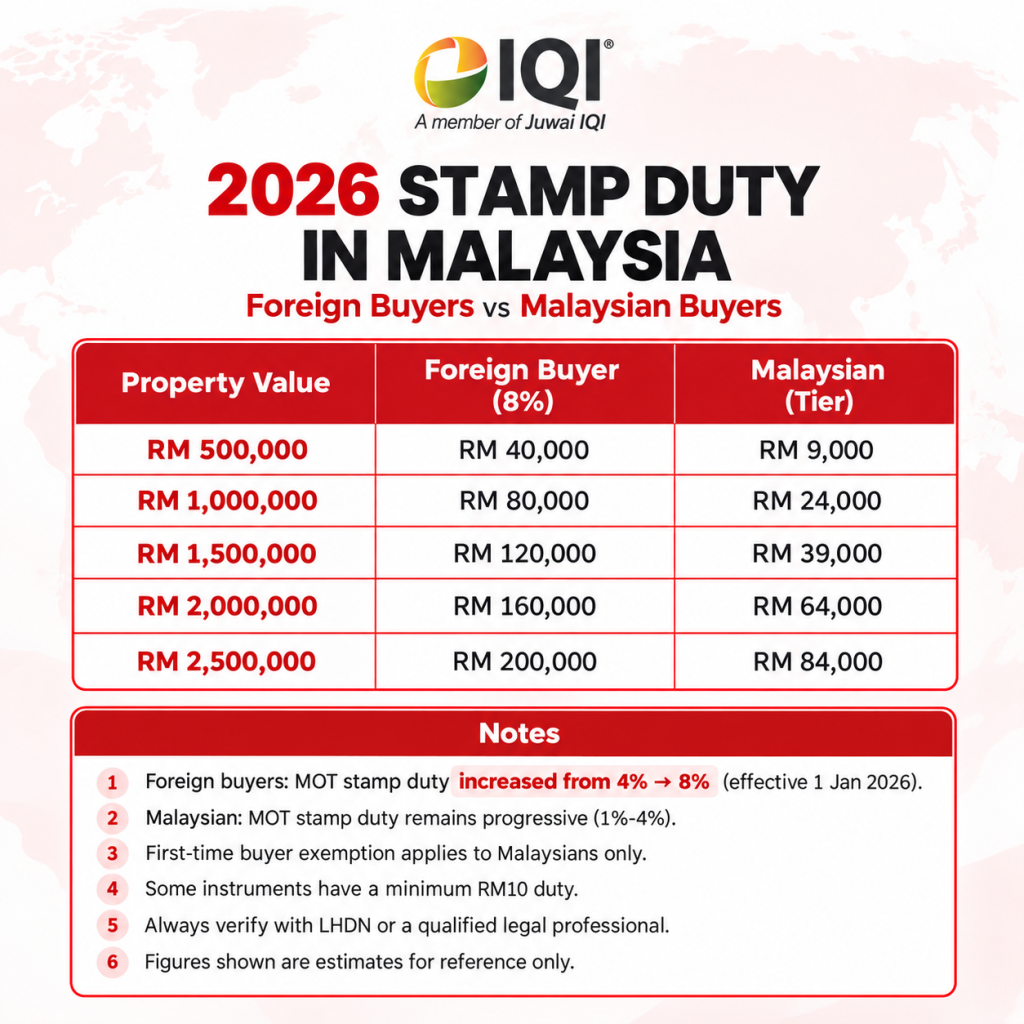
Under Budget 2027, the government proposes extending stamp duty exemptions for Malaysian citizens buying their first residential property.
First-home price | Proposed stamp duty treatment |
|---|---|
RM500,000 and below | 100% exemption on the loan agreement and property transfer instrument |
Above RM500,000 up to RM750,000 | Full exemption on the first RM500,000 and 50% on the remaining eligible amount |
Above RM750,000 | Not eligible under this particular proposal |
The proposed exemption applies to qualifying sale and purchase agreements signed from 1 January 2027 until 31 December 2030.
Stamp duty is a tax on certain legal documents in a property purchase, including the transfer of ownership (memorandum of transfer) and the housing loan agreement.
Which stamp duty band does the average home in your state fall into?
Comparing NAPIC's H1 2026 average prices with the proposed thresholds shows why the new RM500,000 to RM750,000 band matters.
State | Avg house price (H1 2026) | Proposed band for a first home at this price |
|---|---|---|
Johor | RM489,881 | Full exemption |
Penang | RM503,388 | Partial (RM500,000 to RM750,000) |
Sabah | RM558,358 | Partial (RM500,000 to RM750,000) |
Selangor | RM561,187 | Partial (RM500,000 to RM750,000) |
Sarawak | RM574,099 | Partial (RM500,000 to RM750,000) |
Kuala Lumpur | RM825,282 | Not eligible (above RM750,000) |
In four of the six states, the average home sits in the new partial-exemption band. In Kuala Lumpur, a first-time buyer would need to look below the average price to qualify at all.
IQI's own data points the same way. In 2025, our new-launch buyers paid an average of RM597,686 in Selangor and RM726,529 in Johor. Both sit inside the proposed partial-exemption band.
Averages include larger and higher-end homes, so many first homes will cost less than these figures. Check the exact price of the unit you are considering.
Worked example: how much could a first-time buyer save?
Take a first home priced at RM600,000 with a 90% loan of RM540,000. Under the standard scale rates:
- Stamp duty on the transfer: RM12,000 (1% on the first RM100,000, 2% on the next RM400,000, 3% on the remaining RM100,000)
- Stamp duty on the loan agreement: RM2,700 (0.5% of RM540,000)
- Total without relief: RM14,700
If the proposal works as described (full exemption on the first RM500,000, 50% on the balance), the buyer would pay about RM1,600. That is a saving of roughly RM13,100 in cash needed upfront.
Illustrative estimate based on the proposal as announced. Final savings depend on the gazetted rules, the actual loan amount and eligibility. Use our property transaction fees calculator to estimate your own costs.
However, these savings do not lower the selling price or the monthly repayment. Buyers still need the down payment, legal fees and other purchase costs.
Want the full list of costs beyond stamp duty? See the real cost of buying a house in Malaysia.
What would the average home cost each month?
At the national average price of RM506,317, a 90% loan (RM455,685) over 35 years at an illustrative 4% interest rate works out to about RM2,018 a month.
That is roughly 29% of the 2024 median household income of RM7,017. Manageable for many households, but tight for single-income buyers. Run your own numbers before you fall for a unit.
Estimates for guidance only. Actual figures depend on the bank's assessment, current rates, and your full financial profile.
Could more Malaysians qualify for housing financing?
Budget 2027 also provides up to RM20 billion in housing financing guarantees through SJKP, targeting about 80,000 first-time homebuyers.
For scale, 80,000 buyers equals about 31% of all residential transactions recorded in 2025 (256,512). The timeline for reaching them has not been specified, but the potential reach is significant.
SJKP, or Syarikat Jaminan Kredit Perumahan, helps eligible buyers get financing through participating financial institutions.
This is particularly relevant for freelancers, business owners and gig workers whose income may not be fixed every month.
However, financing guarantees are not cash grants or automatic loan approval. Banks still assess whether applicants can afford the repayments, usually through the debt service ratio (DSR).
Check your debt service ratio
Your DSR compares your monthly debt commitments with your income. It is one of the first things a bank looks at.
Estimates for guidance only. Each bank sets its own DSR limits.
What does this mean for homebuyers?
These measures could remove some barriers to ownership, especially for eligible first-time buyers.
But affordability should not be measured by incentives alone. Consider how much you can comfortably repay each month, how much cash you have saved, and whether you could cope if your finances change.
What to check before buying: Calculate your total upfront costs and monthly commitments before deciding how much to spend.
Not sure which schemes you qualify for? Compare your options in our first-home schemes guide.
The Budget changes the costs. The local market decides the value.
An IQI agent can check whether your target home qualifies for the proposed stamp duty relief, compare it with recent transactions in the area, and show you how much unsold stock is nearby. Free, and no pressure.
Talk to a local IQI agent and buy with confidence
Or browse now: subsale homes and new launches.
Could Budget 2027 affect property prices in Malaysia?
One common question after any Budget is whether property prices will rise or fall. The answer is not straightforward.
Budget 2027 introduces housing incentives and infrastructure spending, but these measures do not set prices. Supply, demand, financing conditions and location do.
How do supply and demand affect property prices?
Housing supply is the number of homes available in a market. Housing demand is the number of people willing and able to buy them.
If a neighbourhood has many newly completed condominiums but few interested buyers, sellers face stronger competition. An established neighbourhood with limited stock and steady demand may behave very differently.
The NAPIC data shows both situations in the same market. Landed launches sold at 22.8% in H1 2026, while high-rise launches sold at only 8.2%. Serviced apartment overhang (which NAPIC counts separately as commercial) jumped 30.7% to 23,375 units.
In plain terms, the oversupply problem is concentrated in high-rise and serviced apartments, not across the whole market.
Could new housing projects increase supply?
Budget 2027 provides nearly RM1 billion for housing initiatives, including Rumah Mesra Rakyat and Program Residensi Rakyat.
Four new housing projects were also announced in Kulai, Nilai, Paya Rumput and Pertang Valley.
These developments could improve housing availability for eligible households. However, government housing programmes serve specific buyer groups and should not be treated like ordinary private projects.
Their wider effect depends on project scale, location, eligibility and completion timelines.
What about abandoned housing projects?
The government has also proposed stamp duty exemptions for the revival of qualifying abandoned housing projects.
This could reduce some transaction costs involved in restarting stalled developments, and eventually add usable homes to the market.
The actual effect depends on how many projects are completed and where they are.
What does this mean for buyers and investors?
Rather than expecting Budget 2027 to push all prices one way, look at individual neighbourhoods.
Check recent completed transactions, similar properties for sale, upcoming developments and existing demand.
What to check before buying: Is the property fairly priced against similar homes nearby, and is there enough demand to support its long-term value?
For a closer look at recent subsale prices, see Malaysia subsale prices in Q1 2026.
Which Malaysian property markets could benefit from Budget 2027?
Apart from housing incentives, Budget 2027 highlights investment and infrastructure across several regions.
These may influence demand over time, especially where they create jobs and improve connectivity. But the data shows each state is starting from a different position.
Johor: could JS-SEZ create stronger housing demand?
The Johor-Singapore Special Economic Zone (JS-SEZ) is one of the developments highlighted in Budget 2027.
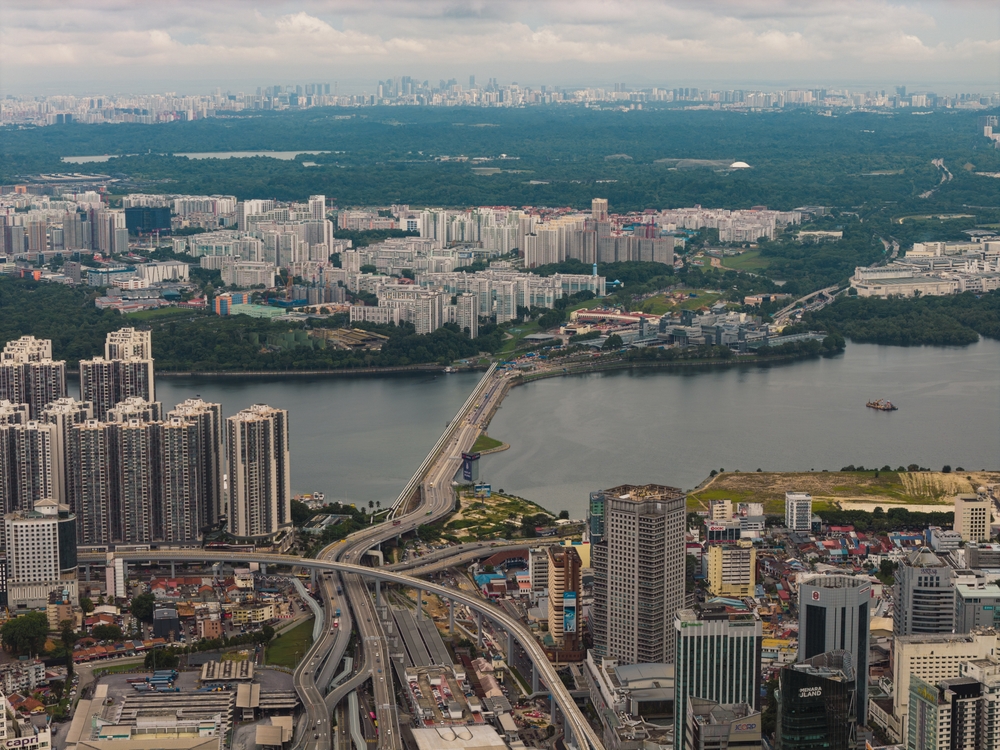
According to the official Budget Speech, the JS-SEZ recorded RM132 billion in investments between 2025 and June 2026. The government also highlighted Nexus Sedenak, an industrial development with potential investments of RM12 billion and about 45,000 jobs.
Where Johor stood in H1 2026:
- Prices rose 3.6%, the fastest of the six states, after +6.9% in 2025.
- Johor's price index (313.9) is the highest of the six, meaning prices have roughly tripled since 2010.
- New launches sold at 36.5%, more than double the national rate.
- But residential transactions fell 15.1%, and the overhang rose 31.6% to 4,222 units worth RM3.72 billion.
- Total property transaction value rose 8.2% even as residential value fell 7.7%, suggesting non-residential deals are driving much of the activity.
What IQI's own transactions show in Johor:
- IQI's new-launch bookings in Johor rose from 407 in 2023 to 2,198 in 2025, more than five times higher in two years.
- The average new-launch price paid by those buyers rose to RM726,529 in 2025, well above NAPIC's state average of RM472,977.
- Average rents rose 22.8% between 2023 and 2025, to RM2,227 a month, but have eased to RM2,097 so far in 2026.
For the property market, the link is employment. If businesses expand and hire, more workers will need homes near their workplaces.
However, a large investment figure does not automatically create immediate rental demand. Johor already has the most unsold completed homes of these six states.
Investors should check whether companies have started operating, how many workers are actually employed, and whether suitable housing already exists nearby.
What to watch in Johor: Employment growth, industrial project progress, commuting routes, the overhang trend and actual rental demand.
Exploring Johor? Read our guide to Johor-Singapore Special Economic Zone opportunities.
Selangor: could industrial expansion support nearby residential areas?
Budget 2027 highlights a RM1.25 billion New Economy Venture Fund involving Sime Darby Property, EPF and LTAT. The fund supports data centres and industrial logistics assets in Elmina, Selangor.
Where Selangor stood in H1 2026:
- rices fell 1.1%, the only decline among the six states.
- Residential transactions fell 10.5% to 22,389, still the largest volume of the six states.
- The overhang rose 69.8% to 4,185 units, and 15,665 unsold units were still under construction, the largest pipeline of the six.
- Only 6.8% of new launches sold, the lowest rate of the six.
- IQI's data shows tenant demand holding up: the average Selangor rent rose to RM2,001 so far in 2026, up from RM1,792 in 2023.
These developments could strengthen business activity and attract supporting industries. However, different industries create different housing needs.
A data centre may involve large investment but relatively few permanent staff compared with a manufacturing plant. With supply already rising, Selangor buyers have more bargaining power than they did a year ago, but investors should not assume new industrial projects will quickly absorb it.
What to watch in Selangor: Types of businesses, permanent employment, transport access and the volume of competing new launches nearby.
Weighing the Klang Valley? See why investors look at the Klang Valley.
Kuala Lumpur and Penang: steady prices, different pressures
Budget 2027 has fewer headline projects for these two markets, but they remain major buying decisions for many readers.
Kuala Lumpur was the most resilient on volume, with residential transactions up 2.4% and prices up 2.7%. At RM825,282, its average price is the highest in Malaysia and above the proposed stamp duty ceiling of RM750,000. IQI's KL rents have also climbed to an average of RM3,073 a month so far in 2026.
Penang was flatter. Prices rose only 0.2%, transactions fell 13.1%, and new launches nearly doubled (+79.9%) while selling at just 9.8%. That points to more supply competing for fewer buyers.
The difference is who the market serves: KL is increasingly a higher-end market, while Penang's pressure is on new supply.
Sabah and Sarawak: could better connectivity create new opportunities?
Budget 2027 announced federal allocations of RM18.7 billion for Sabah and RM16.2 billion for Sarawak. It also provides RM3.3 billion for road projects across both states and highlights cross-border connectivity.
Where East Malaysia stood in H1 2026:
- Sabah prices rose 2.9% to an average of RM558,358, and its overhang fell 4.1% to 1,887 units.
- Sabah's total property transactions jumped 25.7%, although residential deals dipped 1.5%.
- Sarawak prices rose 2.7% to RM574,099, and residential transactions grew 2.4%.
- New launches in Sabah dropped to just 206 units, down 83.8%, which limits fresh supply.
East Malaysia showed the steadiest balance of price growth and supply among the six states in H1 2026, though from smaller transaction volumes.
Better roads may reduce travel time between homes and workplaces. But new infrastructure does not make every nearby location a strong investment. The long-term benefit depends on whether connectivity brings more business activity, population growth and housing demand.
What to watch in East Malaysia: Project completion, transport access, employment centres, local population trends and available housing supply.
A quick regional comparison
Region | Budget 2027 highlight | Market position (H1 2026) | Main consideration |
|---|---|---|---|
Johor | JS-SEZ and Nexus Sedenak | Fastest price growth (+3.6%), best launch take-up, largest overhang | Actual job creation vs rising supply |
Selangor | Data centres and logistics in Elmina | Prices down 1.1%, overhang up 69.8% | Type and scale of employment |
Kuala Lumpur | My50, MyKomuter50 and rail upgrades | Volume and prices both up, average above RM800,000 | Stamp duty eligibility for first-time buyers |
Sabah | Roads and infrastructure | Prices up 2.9%, overhang down 4.1% | Completion and local demand |
Sarawak | Connectivity and regional economic initiatives | Prices up 2.7%, transactions up 2.4% | Local business and population growth |
These are potential market influences, not forecasts of guaranteed price growth.
Will better public transport make certain properties more attractive?
Property affordability goes beyond the purchase price. For daily commuters, transport costs and travel time can make a real difference to monthly expenses.
Budget 2027 continues the My50 public transport pass and introduces MyKomuter50 for KTM Komuter users. According to the official Budget Speech, MyKomuter50 could save eligible commuters an average of up to RM160 a month.
The government also announced further rail improvements, including train procurement and investment in service reliability.
Why does this matter when choosing a property?
Imagine comparing two homes:
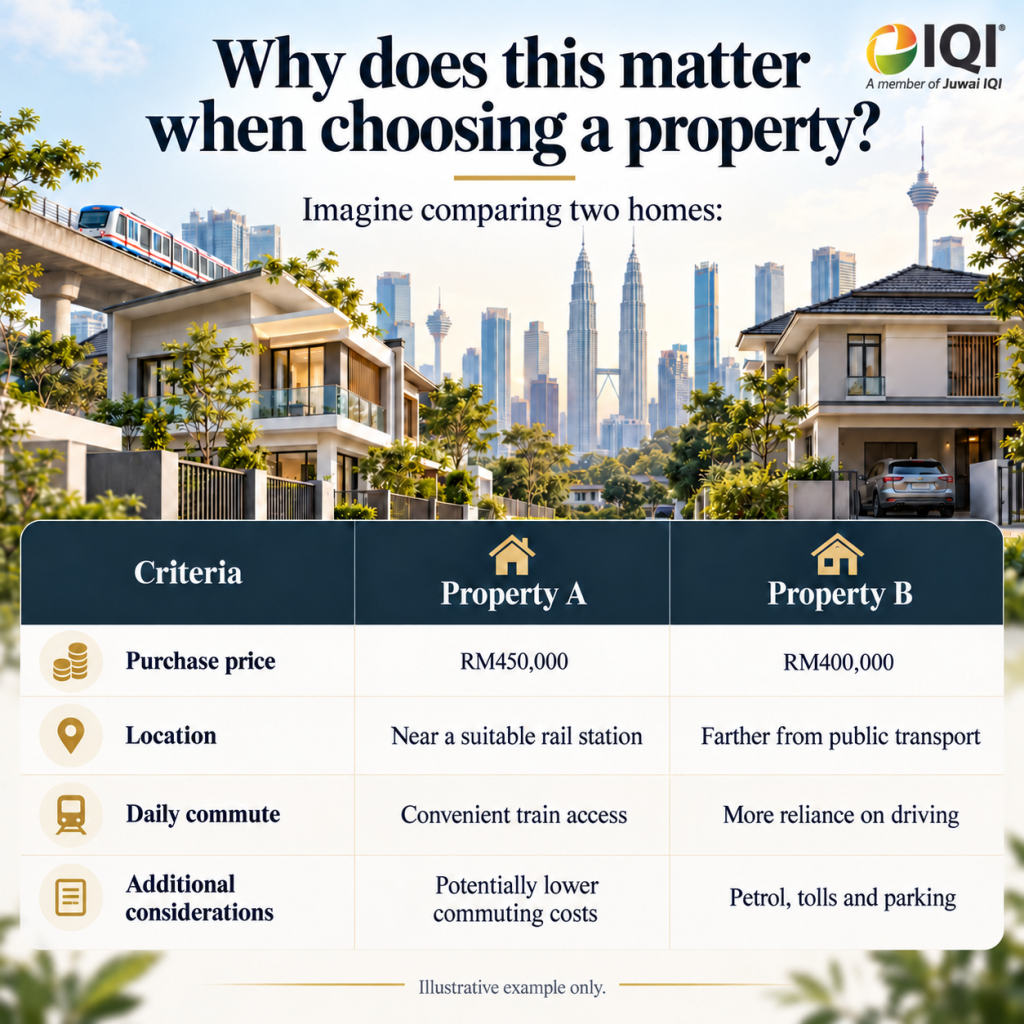
Property B is cheaper upfront but may cost more to live in every day. Depending on your work and commute, Property A could be better value despite the higher price.
Not everyone works near a train station, and homes near public transport do not automatically offer better value. Compare your actual travel routes and costs.
What about the ECRL?
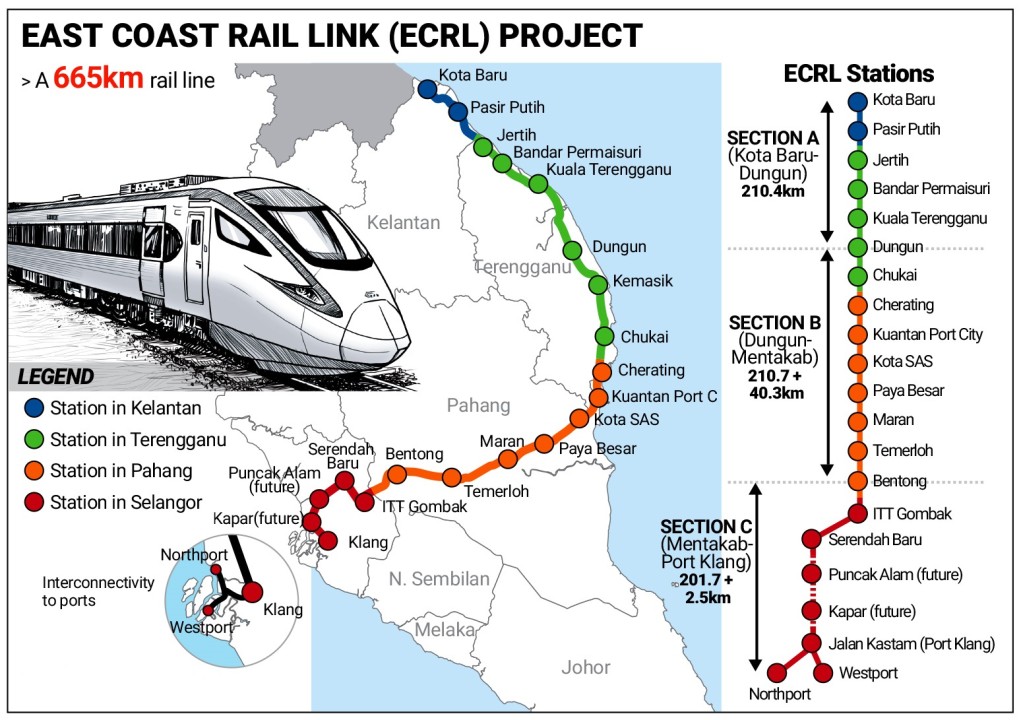
The East Coast Rail Link (ECRL) is another project worth monitoring. Budget 2027 highlighted the expected start of Phase 1 operations from Kota Bharu to the Gombak Integrated Terminal in December 2026.
Improved connectivity could gradually change how residents and businesses use areas along the route. The effect on property will depend on station access, service patterns, nearby development and local demand.
What to check before buying: Compare the property's monthly ownership costs with your expected transport costs and travel time.
Could tourism growth create more rental property opportunities?
Budget 2027 allocates RM935 million for tourism and cultural development, including promotion and facilities.
For investors, this raises questions about accommodation demand in established tourist areas.
Could tourism support short-term rental demand?
More visitors may benefit accommodation providers where tourists regularly stay. But tourism growth does not guarantee strong returns for individual units.
The NAPIC data is a useful reality check. Serviced apartments, a common short-term rental choice, had 23,375 unsold completed units at end-June 2026, up 30.7% in a year and worth RM19.33 billion. That is a crowded field to compete in.
A serviced residence near established attractions serves a different market from an ordinary apartment farther away. Location, competition, operating costs and accommodation type all matter.
What should investors calculate?
Two key measures are rental yield and occupancy rate.
Rental yield measures annual rental income relative to the purchase price. For example, a RM500,000 property earning RM2,000 a month in rent produces:
- Annual rent: RM2,000 × 12 = RM24,000
- Gross rental yield: RM24,000 ÷ RM500,000 × 100 = 4.8%
How realistic is 4.8%? IQI's 2025 transaction data suggests indicative gross yields of about 3.5% to 4.9% across the six states, with Sabah (4.9%) and Johor (4.8%) at the top and Kuala Lumpur at 3.8%. In KL, yields have narrowed from about 4.5% in 2023 because subsale prices rose faster than rents.
Gross yield does not deduct maintenance, repairs, management fees or empty periods. Occupancy rate measures how often the property is actually occupied.
Both matter for short-term accommodation. Check local regulations and building management rules before operating a short-term rental.
What to check before buying: Compare realistic rental income with ownership and operating costs, rather than relying on tourism announcements.
Malaysia property investment 2027: what risks should investors consider?
Budget 2027 highlights economic opportunities, but not every project in a high-growth region will deliver strong returns. Here are four risks, each visible in the latest data.
Risk 1: Too many competing properties
An area can attract investment and jobs while also adding many new homes. If supply grows faster than buyer or tenant demand, competition rises.
Nationally, completed unsold homes rose to 33,094 units in H1 2026. In Selangor, the overhang rose almost 70% in a year. More supply means longer selling times and pressure on rents.
Risk 2: Investment announcements take time to produce results
An announced industrial project may take years to become fully operational, and its effect on local jobs may differ from early expectations.
Johor shows this clearly: billions in announced investment, yet residential transactions fell 15.1% in H1 2026. Avoid assuming future investment creates demand today.
Risk 3: Rental income may not cover ownership costs
A property can earn rent and still require you to top up every month. Rent may not cover loan repayments, maintenance fees, repairs and other costs.
Calculate expected monthly cash flow before buying. Cash flow is what is left after rental income minus all property-related expenses.
Risk 4: Property values are not guaranteed to increase
Capital appreciation is an increase in a property's value over time. National price growth slowed from 3.3% in 2024 to 0.9% in Q2 2026, below inflation.
Some locations may benefit from infrastructure and economic activity, but there is no guarantee any property will rise in value. Make sure you can hold the property for your intended period if conditions change.
Malaysia property market outlook 2027: what could change after the Budget?
The H1 2026 data is a starting line, not a forecast. These are the developments most likely to shift the picture over the next 12 to 18 months.
- Timing of the stamp duty relief. If the proposal applies to agreements signed from 1 January 2027, some buyers in the RM500,000 to RM750,000 range may wait until then to sign. Watch for a dip in late 2026 and a pickup in early 2027.
- How quickly SJKP guarantees roll out. Reaching 80,000 first-time buyers would be a meaningful boost to demand at the lower and middle end of the market.
- Whether the overhang keeps rising. With 58,611 unsold units still under construction, completions could add to the overhang unless sales improve.
- New launch discipline. Developers cut launches by 25.3% in H1 2026. Continued restraint would help clear existing stock.
- Interest rates. Bank Negara Malaysia's Overnight Policy Rate decisions directly affect monthly repayments and loan eligibility.
- Project delivery. JS-SEZ hiring, Nexus Sedenak, ECRL Phase 1 operations and East Malaysian road projects all need to move from announcement to reality.
The next checkpoints are NAPIC's full-year 2026 property market report, expected in early 2027, and DOSM's 2026 household income survey results, also due in 2027.
Should you buy or invest in property after Budget 2027?
Budget 2027 introduces potentially helpful measures, but the decision to buy should depend on your financial readiness and purpose.
A first-time buyer, a family upgrading and a rental investor may read the same Budget very differently.
If you're a first-time homebuyer
Focus on affordability and available help. Check whether you qualify for stamp duty relief, SJKP financing support or relevant housing programmes.
Calculate your upfront costs and make sure monthly repayments stay manageable. The softer market in many states may also give you more room to negotiate. Do not stretch your budget just because an incentive exists.
If you're buying a home for your family
Prioritise your household's daily needs: access to work, schools, healthcare and public transport.
Think about how the home will suit your family over the next five to ten years. A suitable location can matter more than short-term market movements.
If you're buying a property for rental income
Focus on actual tenant demand rather than headlines about new investment.
Study rental transactions where available, competing properties, nearby overhang, typical occupancy and tenant preferences. Calculate whether the expected income covers your costs.
If you're investing for long-term value growth
Look at how the surrounding area is developing: employment centres, transport improvements, population growth and future residential supply.
Investment announcements can be useful signals, but actual implementation and local demand should carry more weight.
Building a longer-term plan? See our guide to property investing strategies in Malaysia.
Property buying decision checklist
Before buying, ask yourself:
- Can I comfortably afford the down payment and other upfront costs?
- Does my target home qualify for the proposed stamp duty relief, and in which band?
- Will the monthly repayment leave enough room for savings and emergencies?
- Is the price reasonable compared with recent transactions for similar properties nearby?
- How much unsold or upcoming supply is in the same area?
- Does the location suit my personal needs or my intended tenant market?
- Are the announced infrastructure or employment projects actually progressing?
- If I'm investing, what happens if rental income is lower than expected?
- Am I buying for a clear purpose, rather than fear of missing out?
A property that makes financial sense today should not depend entirely on future government projects delivering.
What should real estate agents focus on after Budget 2027?
For agents, Budget 2027 is a chance to help clients make better-informed decisions, not just repeat the headlines.
The NAPIC data gives agents concrete talking points:
- First-time buyers: which stamp duty band their target home falls into, and their SJKP eligibility.
- Families: commuting costs, amenities and long-term suitability.
- Investors: local overhang, launch take-up rates, infrastructure progress and realistic rental yields, which IQI's data puts at about 3.5% to 4.9% gross.
- Buyers torn between new and old: in Johor and Penang, IQI's new-launch buyers paid around 30% more than subsale buyers in 2025.
Most importantly, agents should help clients separate announced investment from confirmed market opportunity. That builds trust based on realistic expectations, not speculation.
Frequently asked questions about the Budget 2027 property market outlook
What is the Malaysia property market outlook for 2027?
The market enters 2027 on a softer footing: residential transactions fell 7.7% in H1 2026, price growth slowed to 0.9% and the overhang rose to 33,094 units. Budget 2027's stamp duty relief and SJKP financing guarantees could lift first-time buyer demand from 2027, while rents remain firm. The outlook will vary by state and depends on overhang, interest rates and project delivery.
Will property prices increase in Malaysia after Budget 2027?
Budget 2027 does not guarantee higher prices. Before the Budget, national price growth had already slowed to 0.9% in Q2 2026, the slowest since 2022. Investment and infrastructure could support demand in selected areas, but prices will depend on location, supply, buyer demand and economic conditions.
What is the average house price in Malaysia in 2026?
According to NAPIC's Malaysian House Price Index, the national average house price was RM506,317 in Q2 2026 (preliminary). Among major states, Kuala Lumpur was highest at RM825,282 and Johor lowest of the six covered here at RM489,881.
How many unsold homes are there in Malaysia?
NAPIC recorded a residential overhang of 33,094 completed, unsold units worth RM17.78 billion at end-June 2026, up 8.6% from end-2025. A further 23,375 serviced apartment units were also unsold. Johor (4,222 units) and Selangor (4,185 units) had the largest overhangs of the six states covered in this article.
Is 2027 a good year to buy property in Malaysia?
It depends on your financial readiness, purpose and location. Eligible first-time buyers may benefit from proposed stamp duty exemptions and SJKP financing support, and a softer market in some states may give buyers more negotiating room. Still compare prices carefully and check your ability to repay a loan.
Final thoughts: Budget 2027 creates opportunities, but the data says choose carefully
Malaysia Budget 2027 introduces measures that could improve access to housing and support economic development across the country.
It arrives at a turning point. The economy is growing at nearly 6%, yet housing transactions are down, price growth has slowed below inflation, and unsold stock is rising. At the same time, IQI's own data shows rents still climbing in most states.
For homebuyers, that combination of new incentives and a softer market may be a better buying window than the headlines suggest, provided the numbers work for you.
For investors, industrial growth, infrastructure and tourism may offer areas worth monitoring. But a strong investment announcement does not automatically mean a strong property investment.
What matters is whether these developments turn into real housing demand, better connectivity and lasting economic activity.
Whether you're buying your first home, upgrading for your family or considering an investment, base your decision on affordability, local data and long-term goals.
Wondering if Budget 2027 changes what you can afford, or where you should buy? Our property consultants will check your eligibility, compare real prices in your area and help you decide with confidence. Fill in your details below to connect with them directly.
[custom_blog_form]
Continue reading:
- NAPIC H1 2020 Report | 12 Things You Should Know
- Cyberjaya Property 2026: Weekend Spots, Real Prices and Real Yields
- Buying Property in Klang Valley: The Complete 2026 Guide
- [Infographic] Malaysia Property Outlook H1 2022
- Ringgit Strong in 2026: Why Cost of Living and Property Still Feel Expensive in Malaysia
Source:
- NAPIC: Property Market Report H1 2026
- NAPIC: Property Market Report 2025
- NAPIC: Property Market Status Report H1 2026
- NAPIC: Malaysian House Price Index Q1 to Q2 2026P
- NAPIC regional property market reports H1 2026: Central, Southern, Northern, East Malaysia
- DOSM / OpenDOSM: GDP, inflation, labour force and income data
- Ministry of Finance: Q2 2026 GDP press release
- Ministry of Finance: Budget 2027 Speech, 9 October 2026
- IQI Global: internal residential transaction records, 2023 to 2026 (year to date as at 7 October 2026)
Ready to Find Your Perfect Property?
IQI Global understands the property market intimately. We're not just agents — we're guides helping you understand investment potential, lifestyle benefits, and long-term value.
Know the author
Unlock Exclusive Insights
Subscribe to our emails to find out about the latest market insights, property news and trends.
Ready to Find Your Perfect Property?
IQI Global understands the property market intimately. We're not just agents — we're guides helping you understand investment potential, lifestyle benefits, and long-term value.
You may also like

How Industrial Growth Is Reshaping Malaysia’s Property Market in 2027

Indonesia Global Market Insights: Prices, Yields & Outlook 2026

Why Kuching Is Becoming One of Malaysia’s Cities to Watch in 2027