Buying Property in Malaysia: A Step-by-Step Guide (2026)
Buying property in Malaysia is not complicated. It just feels that way because nobody hands you the full roadmap at the start.
This guide does. It walks you through 8 steps from setting a budget to collecting your keys, plus the documents, fees, stamp duty and timeline you need to plan for. Whether it is your first home or your next one, start here.
TL;DR
- Buying property in Malaysia follows 8 steps: research, affordability check, viewing, booking, loan comparison, legal process, key handover and cost planning.
- Banks usually finance up to 90% of the price for your first two homes, so plan for at least a 10% down payment.
- Budget another 10% to 15% on top for stamp duty, legal fees, valuation and moving-in costs.
- Most banks want your total monthly debts within roughly 60% to 70% of your income (your DSR).
- First-time Malaysian buyers pay no stamp duty on the transfer and loan agreement for homes up to RM500,000, until 31 December 2027.
- A subsale purchase usually takes 3 to 6 months from booking to keys. A new launch depends on the construction timeline.
The 8 Steps to Buying Property in Malaysia at a Glance
- TL;DR
- Step 1: Where Should You Buy?
- Step 2: How Much Can You Actually Afford?
- Step 3: What Should You Check During a Property Viewing?
- Step 4: How Do You Book a Property and What Documents Do You Need?
- Step 5: How Do You Choose the Right Home Loan?
- Step 6: What Happens During the Legal Process?
- Step 7: When Do You Get Your Keys?
- Step 8: What Costs Should You Budget For Beyond the Price?
- How Long Does Buying Property in Malaysia Take?
- Which Government Housing Schemes Can Help You Buy?
- What Legal Matters Should You Check Before Buying?
- What Mistakes Should You Avoid?
- Frequently Asked Questions
Want the bigger picture first, including buyer types and the best areas to buy in 2026? Read our full guide on how to buy a house in Malaysia.
Step 1: Where Should You Buy?
Before you fall in love with a unit, work out what actually fits your lifestyle and long-term plans.
- Location and access: distance to work, peak-hour traffic, and MRT, LRT or KTM access.
- Price benchmarking: compare subsale and new launch prices, and check recent transaction prices nearby.
- Facilities and environment: security, amenities and how crowded the development feels.
- Future growth: upcoming developments, rental demand and infrastructure plans.
Here is the honest truth: a cheap house in the wrong location can cost you more in time, stress and resale value.
Step 2: How Much Can You Actually Afford?
This is the make-or-break step. It decides what you can realistically buy, so do it before you view a single property.
Banks look at three things: your income, your existing debts and the size of your down payment. Under Bank Negara Malaysia rules, you can usually borrow up to 90% of the price for your first two residential properties, and up to 70% from your third property onwards.
How much can you borrow?
Start here. The calculator below estimates your maximum loan amount based on your income and commitments.
Will your DSR pass the bank's check?
Your Debt Service Ratio (DSR) is the share of your income that goes to debt repayments. Most banks want your total commitments within roughly 60% to 70% of income. A high DSR is one of the most common reasons home loans get rejected. Learn how DSR works.
What will your monthly instalment be?
A safe rule of thumb is to keep your instalment within 30% to 40% of your monthly income. Try different interest rates and tenures below to see how the number moves.
Estimates for guidance only. Actual figures depend on the bank's assessment, current rates, and your full financial profile.
Not sure what your salary can stretch to? See how much home loan you can get with your salary.
Numbers looking tight, or not sure how to read them?
You don't have to figure this out alone. An IQI agent reviews your budget, shortlists homes you can actually afford, and walks you through every step from loan to keys. Free, and no pressure.
Talk to a local IQI agent and buy with confidence
Or browse now: subsale homes and new launches.
Step 3: What Should You Check During a Property Viewing?

Photos online can be flattering. A physical viewing confirms whether the property really matches the listing.
- Is the layout practical for how you actually live?
- Does the unit get natural light and airflow?
- How loud is it? Listen for highways, neighbours and nearby construction.
- What condition is the building in, including lifts, corridors and common areas?
One tip that pays off: visit at different times of the day. A quiet Sunday morning can feel very different from a weekday evening rush.
Step 4: How Do You Book a Property and What Documents Do You Need?
Once you find the right unit, you secure it with a booking. The process differs for new projects and subsale homes.
New project | Subsale | |
|---|---|---|
How you book | Fill in the developer's booking form | Sign a Letter of Offer to Purchase (OTP) |
What you pay | Booking fee, typically RM500 to RM5,000 | Earnest deposit, typically 2% to 3% of the price |
Next step | Loan application, then SPA signing | Loan application, then SPA signing and balance of the 10% deposit |
Speed matters here. Good units do not stay on the market for long, so have your documents ready before you view.

Documents for salaried buyers
- MyKad (identity card)
- Latest 3 to 6 months' salary slips
- Latest EPF statement
- EA Form or Borang BE for the past 2 years
- Latest 3 to 6 months' bank statements
- Letter of employment, if requested
- Booking receipt or signed OTP (the bank will need the SPA later)
Extra documents for self-employed buyers
- Business registration documents (SSM)
- Latest 6 months' company bank statements
- Borang B for the past 2 years
No fixed payslip? Gig workers have options too. Ask an IQI agent which banks and schemes accept your income type.
Step 5: How Do You Choose the Right Home Loan?
Do not just take the first bank that says yes. Even a 0.1% difference in rate can save you thousands over a 30 to 35 year loan.
Apply to at least 3 banks and compare:
- Interest rate and how it is calculated
- Lock-in period and early settlement penalty
- Flexi features, such as making extra payments and withdrawing them later
- Monthly instalment and total interest over the tenure
Which loan type suits you?
Choice | Option A | Option B |
|---|---|---|
Rate type | Floating: moves with the OPR and the bank's base rate | Fixed: predictable instalments, usually for a set period |
Structure | Conventional: interest-based loan | Islamic: Shariah-compliant financing based on profit rate |
Flexibility | Flexi or semi-flexi: extra payments reduce interest | Term loan: simpler, often a slightly lower rate |
Compare the details in our guide to flexi, semi-flexi and fixed home loans, and check this month's latest house loan interest rates.
What bank promotions should you look out for?
- Zero Moving Cost (ZMC) packages, where legal and valuation fees are covered or added to the loan
- Lower rates for first-time buyers
- Cashback offers
- Special Islamic home financing plans
Read the fine print on ZMC. If the fees are financed into your loan, you still pay them, just with interest over time.
Once you submit, loan approval usually takes about 1 to 2 weeks. The bank then issues a Letter of Offer with the approved amount, rate and terms.
Step 6: What Happens During the Legal Process?
After your loan is approved, the paperwork moves into the lawyers' hands. You will sign two key documents:
- Sale and Purchase Agreement (SPA) with the seller or developer
- Loan agreement with your bank
Your lawyer then handles the title search, stamp duty, and the transfer of ownership through the Memorandum of Transfer (MOT).

For a subsale, you normally top up your earnest deposit to 10% when signing the SPA. The bank then releases the balance within the completion period, which is usually 3 months, with a possible 1-month extension.
Buying a new launch? Many developers now offer electronic signing. See how eSPA signing with iDsaya works.
Step 7: When Do You Get Your Keys?
This final milestone depends on the type of property you bought.
- Subsale: once the full payment is made and ownership is transferred, the seller hands over the keys.
- New project: you receive Vacant Possession (VP), inspect the unit for defects, and report any issues to the developer within the Defect Liability Period, generally 24 months for residential projects.
Do not rush the inspection. A proper defect check now can save you costly repairs later.
Step 8: What Costs Should You Budget For Beyond the Price?
The down payment is only the start. Plan for costs before, during and after the purchase.
Before buying | During the purchase | After getting keys |
|---|---|---|
Booking fee or earnest deposit | Legal fees for the SPA and loan agreement | Renovation and furniture |
Down payment (usually 10%) | Stamp duty on the MOT and loan agreement | Maintenance fee and sinking fund |
Valuation fee (roughly 0.25% of the price) | Utility deposits and insurance (MRTA or MLTA, fire insurance) |
As a rule, keep a 10% to 15% buffer on top of your down payment. It stops a surprise bill from derailing the purchase.
How much is stamp duty on property in Malaysia?
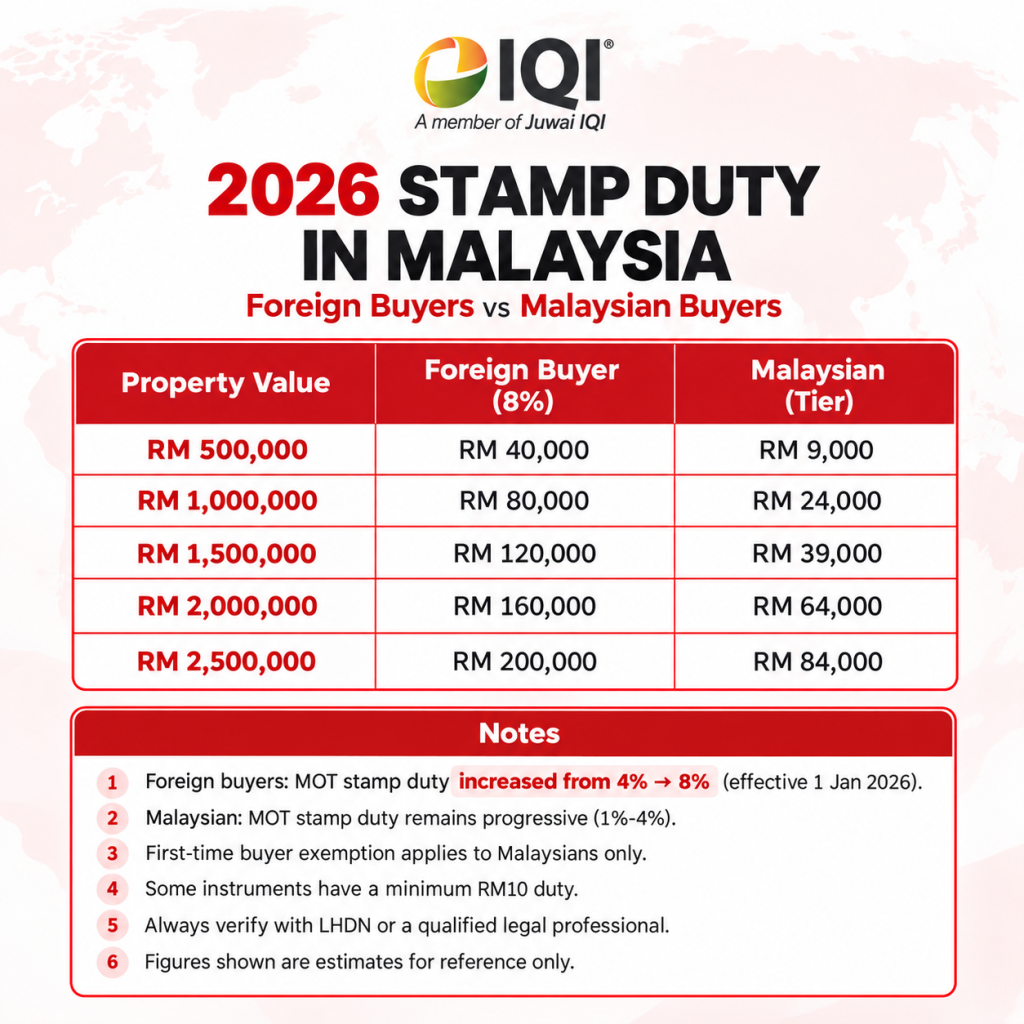
Stamp duty on the Memorandum of Transfer (MOT) is tiered for Malaysian citizens and permanent residents:
Property value | Stamp duty rate |
|---|---|
First RM100,000 | 1% |
RM100,001 to RM500,000 | 2% |
RM500,001 to RM1,000,000 | 3% |
Above RM1,000,000 | 4% |
Worked example: on a RM500,000 home, MOT stamp duty is RM1,000 on the first RM100,000 plus RM8,000 on the next RM400,000, so RM9,000 in total. Stamp duty on the loan agreement is a further 0.5% of the loan amount, which is RM2,250 on a RM450,000 loan.
Good news for first-time buyers: Malaysians buying their first home priced up to RM500,000 are exempt from stamp duty on both the MOT and the loan agreement until 31 December 2027. In the example above, that saves RM11,250.
Foreign buyers pay a higher flat stamp duty rate and must also meet state minimum price thresholds and consent requirements, so check the latest rules with your lawyer before committing.
How much are legal fees?
Lawyers' fees for the SPA follow the Solicitors' Remuneration Order 2023: 1.25% on the first RM500,000 and 1% on the next RM7 million. On a RM500,000 home, that is RM6,250, plus disbursements and SST. The loan agreement carries a separate legal fee on a similar scale.
Get a full estimate in seconds with our property transaction fees calculator, and see the hidden fees first-time buyers often miss.
How long will it take to save your down payment?
Plug in your target price and monthly savings to see when you will be ready.
Estimates for guidance only. Actual figures depend on the bank's assessment, current rates, and your full financial profile.
How Long Does Buying Property in Malaysia Take?
Stage | Typical time |
|---|---|
Loan approval | 1 to 2 weeks |
SPA signing | Within about 1 month of booking |
Stamping and loan documentation | 1 to 2 months |
Keys for a subsale (completed property) | 3 to 6 months from booking |
Keys for a property under construction | 24 to 48 months, depending on the project |
Subsale gets you in faster, while a new launch gives you more time to save and stagger payments.
Which Government Housing Schemes Can Help You Buy?
If you are a first-time or lower-to-middle income buyer, these programmes can bring a home within reach:
- PR1MA: affordable homes for middle-income Malaysians. Read the PR1MA guide (BM).
- Residensi Wilayah (formerly RUMAWIP): affordable housing in the Federal Territories. See how to apply.
- Rent-to-Own (RTO): rent first, then buy the home later. Learn how RTO works.
- Skim Jaminan Kredit Perumahan (SJKP): a government guarantee that helps buyers without a fixed salary, such as gig workers, get a home loan.
- First-time buyer stamp duty exemption: full exemption on homes up to RM500,000 until 31 December 2027.
Not sure which scheme fits you? Compare your options in our first-home schemes guide and the B40 and M40 housing schemes.
What Legal Matters Should You Check Before Buying?
- Freehold or leasehold: leasehold land returns to the state when the lease ends, which affects financing and resale. Compare leasehold vs freehold.
- Strata or individual title: check whether the title has been issued, as it affects how ownership is transferred.
- Developer track record: look at past projects, delivery times and build quality.
- Bumiputera lots: some units are reserved under quota and carry resale restrictions.
Always work with a qualified lawyer. Never skip due diligence, however good the deal looks.
What Mistakes Should You Avoid?
- Paying a deposit before checking your loan eligibility
- Accepting the first loan offer without comparing banks
- Spending your whole budget on the down payment, with no buffer for fees
- Ignoring maintenance fees and sinking fund in your monthly budget
- Skipping the defect inspection on a new property
Learn from people who have done it. Read what first-time homebuyers wish they knew and real first-home buyer stories.
Planning to buy property and want it done right? Our IQI agents will help you sort the budget, the loan and the paperwork, so you can focus on finding the right home. Fill in your details below to get in touch.
[custom_blog_form]
Continue reading:
- How to Buy a House in Malaysia: The Complete 2026 Guide
- Latest House Loan Interest Rates
- Hidden Fees First-Home Buyers Should Know
- Leasehold vs Freehold
- Renting Forever or Buying a House?
- What First-Time Homebuyers Wish They Knew
Frequently Asked Questions
How much salary do I need to buy a house in Malaysia?
Aim to keep your monthly instalment within 30% to 40% of your income. On a RM5,000 monthly income, that generally points to a property of around RM300,000 to RM450,000, depending on your other commitments.
How much can I borrow for a home loan in Malaysia?
It depends on your income, existing debts and DSR. Banks usually finance up to 90% of the price for your first two homes and want total repayments within roughly 60% to 70% of income. Use a loan eligibility calculator for an estimate.
What is DSR and why does it matter?
DSR (Debt Service Ratio) is the share of your income that goes to debt repayments. A high DSR is one of the most common reasons home loans get rejected.
What is the minimum down payment for a house in Malaysia?
Usually 10% of the property price for your first two homes. You also need to budget for legal fees, stamp duty and other costs, so plan for a 10% to 15% buffer on top.
Do first-time buyers pay stamp duty in Malaysia?
Malaysian first-time buyers of a home priced up to RM500,000 are exempt from stamp duty on the MOT and the loan agreement until 31 December 2027.
Ready to Find Your Perfect Property?
IQI Global understands the property market intimately. We're not just agents — we're guides helping you understand investment potential, lifestyle benefits, and long-term value.
Know the author
Unlock Exclusive Insights
Subscribe to our emails to find out about the latest market insights, property news and trends.
Ready to Find Your Perfect Property?
IQI Global understands the property market intimately. We're not just agents — we're guides helping you understand investment potential, lifestyle benefits, and long-term value.
You may also like

How Industrial Growth Is Reshaping Malaysia’s Property Market in 2027


Indonesia Global Market Insights: Prices, Yields & Outlook 2026